Governance-by-Design

Defensible Decisions for Drone Ops

AI provides decision support. SwiftVector-style deterministic control loops enforce governance, human authorization is explicit, and every outcome is auditable and replayable. Alpha target: Q2 2026.

  • Audit-ready
  • Human authorization
  • Deterministic replay
SBIR-Ready Artifacts

SBIR-ready artifacts

The governed autonomy stack produces concrete evidence for technical review without implying immediate demo availability.

Accountability

The accountability problem

If AI flags a defect, who is accountable? Enterprises need more than detection accuracy. They need explainability, governance, and defensible decision trails that stand up to FAA, safety, and insurance review.

Core principle

State is the authority

Model outputs are signals, not truth. Authority lives in state, enforced by deterministic reducers. Prompts never bypass safety constraints, operational invariants, or human approval.

“State, not prompts, must be the authority.”
Architecture

Deterministic control loop

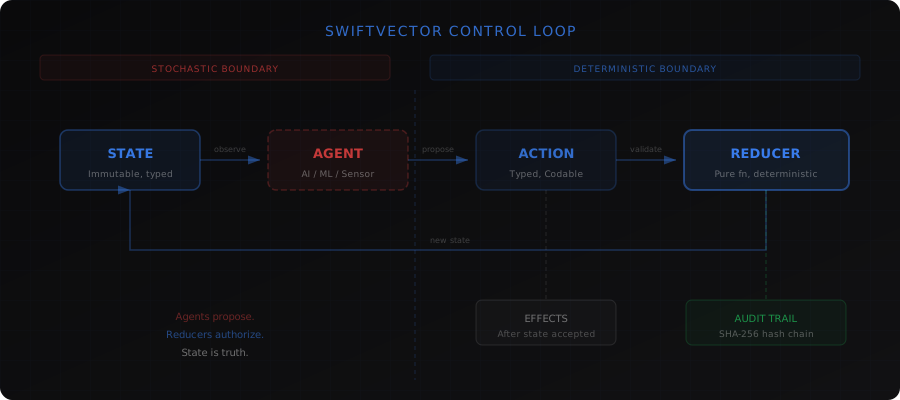
SwiftVector enforces a deterministic state machine that governs every decision. AI agents can propose actions, but reducers decide what becomes real.

SwiftVector control loop: State → Agent → Action → Reducer → New State with audit trail

Agents (stochastic boundary)

Propose actions and predictions based on sensor data and model inference.

Reducers (deterministic boundary)

Validate invariants, apply rules, and authorize state transitions.

Effects

Side effects happen only after state transitions are accepted.

Audit log

Complete decision chain captured for traceability and replay.

Human-in-the-loop

Human approval as explicit state transition

  1. AI proposes a “possible defect” with a confidence score.
  2. System checks constraints: mission phase, airspace, and safety thresholds.
  3. Human approves or denies with timestamp and operator identity.
  4. Execution is logged, attributable, and replayable.
Defensibility

What makes it defensible

Use cases

Governed AI in the field

Fire perimeter monitoring

Multi-asset escalation, task leases, overnight autonomy with degraded mode governance

Thermal inspections

Single-asset inspection with operator present and governed audit trails

UAV mapping

Precision survey missions with deterministic mission planning and approval

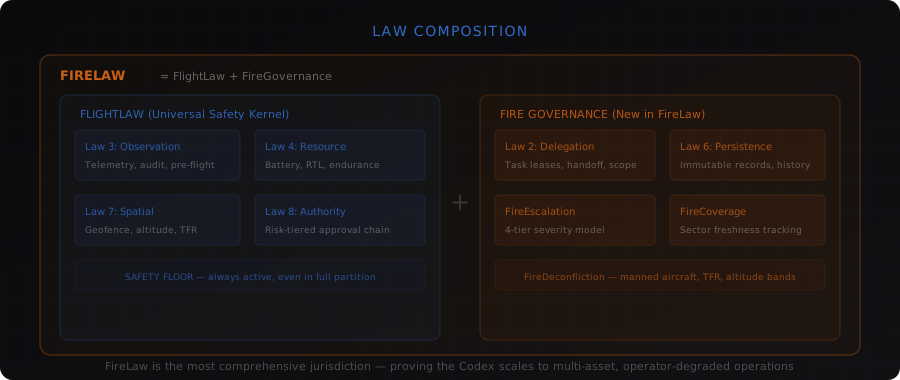
FireLaw = FlightLaw + FireGovernance composition diagram
Proof

Where this is being built

Timeline

Alpha timeline

Alpha target: Q2 2026. Follow development for milestone updates.

Stay aligned with governed autonomy development

Follow progress toward the Q2 2026 alpha and governance-first milestones.