Use Cases
Use cases for governed autonomy workflows
Three governed autonomy workflows that exercise Flightworks Control. Alpha target: Q2 2026.
Three governed autonomy workflows that exercise Flightworks Control. Alpha target: Q2 2026.
Select a use case to see who it's for, the workflow, and how governance supports defensible outcomes.
FireLaw is the most demanding jurisdiction in the Flightworks suite — multi-asset governance, extended autonomous operations, and escalation-tier authority over an overnight burn perimeter.
Define sectors, assign assets, configure escalation thresholds and coverage SLAs.
Operator confirms readiness. System validates constraints before first sortie.
Continuous thermal scans with hotspot classification. AI proposes, reducers authorize.
4-tier deterministic escalation with timeout ladders. Same inputs always produce the same tier.
Battery rotation with task leases. No authority escalation through delegation.
Evidence packages, deterministic replay, and after-action review for every decision.
Overnight fire perimeter monitoring exercises every governance pressure point — the hard problem where deterministic governance justifies its architectural cost.
Fleet-wide task leases with bounded, revocable assignments. No authority escalation through delegation.
Overnight operations require governance that holds without continuous human supervision.
Less information means less authority, never more. When comms fail, the autonomy envelope contracts.
4-tier model from Routine through Emergency. Each tier requires specific authorization levels.
Stochastic inputs (sensor data, ML confidence) cross the determinism boundary. All governance decisions are deterministic and replayable.
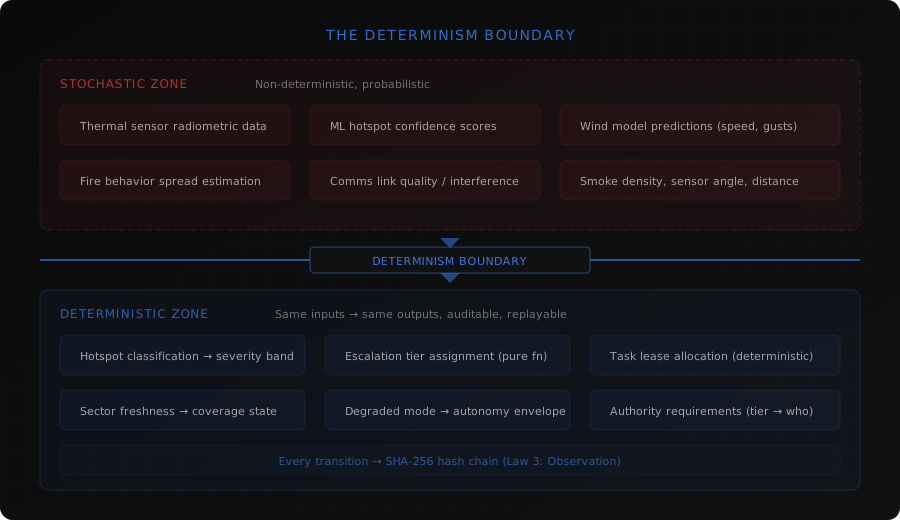
Select projects use field-tested workflows from mission planning through audit-ready documentation.
Draw or import your target boundary. The GCS calculates optimal flight paths based on terrain, desired resolution, and aircraft capabilities.
The system generates waypoints with precise camera triggers, ensuring consistent overlap for photogrammetric processing.
High-resolution cameras capture overlapping images, each geotagged with precise GPS coordinates for accurate positioning.
Photogrammetric processing stitches imagery into orthomosaics, generates elevation models, and creates 3D point clouds.
Crop health monitoring, field boundary mapping, drainage analysis, and yield estimation through regular aerial surveys.
Progress documentation, volumetric calculations, site planning, and as-built surveys with centimeter-level accuracy.
Property surveys, boundary delineation, erosion monitoring, and conservation planning for large areas.
Traditional survey augmentation with dense point clouds, enabling faster data collection over difficult terrain.
Pilot engagements can generate multiple data products for analysis and review.
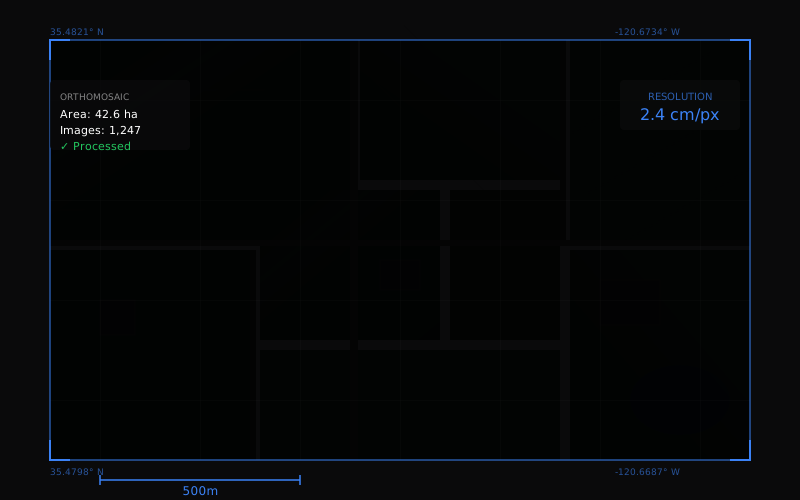
Geometrically corrected, georeferenced aerial imagery stitched into a seamless map with real-world accuracy.
Terrain and surface elevation data for volumetric analysis, drainage modeling, and topographic visualization.
Dense point clouds for detailed measurements, BIM integration, and volumetric calculations.
Infrared cameras detect thermal radiation invisible to the human eye. Temperature differentials reveal problems that would otherwise go unnoticed until failure occurs.
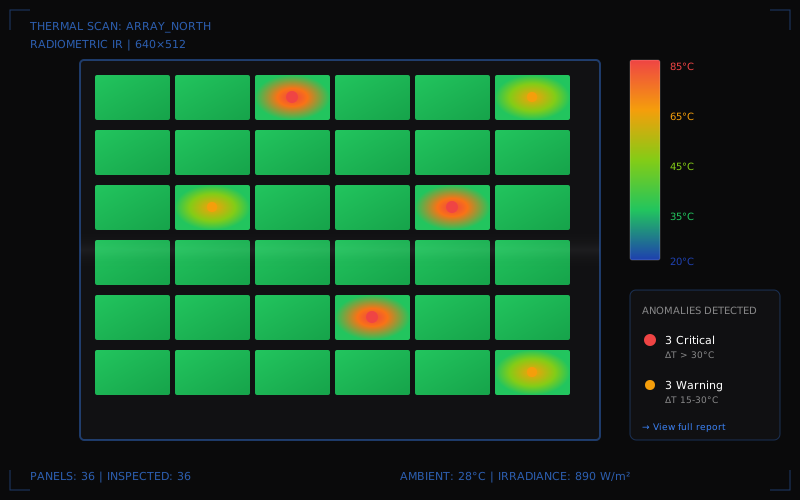
In the visual spectrum, solar panels may appear identical. Thermal imaging reveals hot spots indicating failed cells, bypass diode issues, or connection problems that reduce output and risk fire.
Identify hot spots, failed cells, bypass diode failures, and connection issues across solar installations for field-tested workflows.
Detect thermal bridges, insulation gaps, air leakage, and moisture intrusion in roofs and facades using field-tested workflows.
Locate overheating transformers, loose connections, and overloaded circuits in substations and distribution infrastructure for field-tested workflows.
Monitor mechanical systems, HVAC equipment, pipelines, and processing facilities with field-tested workflows.
Field-tested workflows deliver systematic coverage with repeatable flight patterns and standardized data collection under explicit approvals.
Define inspection area, set camera parameters, and generate optimal flight paths that ensure complete coverage with appropriate overlap.
Consistent altitude, angle, and spacing produce comparable imagery across the entire installation—essential for accurate analysis.
Individual thermal images are stitched into a single, georeferenced map showing temperature distribution across the entire site.
Temperature thresholds identify and classify anomalies. Results are georeferenced for field crews to locate and repair.
Complete temperature map of the inspection area. Georeferenced for GIS integration and field navigation.
Detailed list of identified issues with GPS coordinates, severity classification, and recommended actions.
Visual imagery aligned with thermal data for context. Helps identify physical causes of thermal anomalies.
Get milestone updates, alpha notification (target: Q2 2026), and workflow notes.