Lead Demo Target

Overnight wildfire perimeter monitoring with governed autonomy

FireLaw governs a fleet of drones performing continuous thermal perimeter monitoring with deterministic escalation when conditions change. The operator sets the mission parameters — the system maintains coverage autonomously, escalating only when governance requires human judgment.
The Problem

Overnight monitoring is the hardest governance problem

Active wildfire perimeters require continuous monitoring, especially overnight when ground crews withdraw and wind shifts create the highest risk of perimeter escape.

Situational awareness gaps

Smoke obscures visual scouting. Ground crews have delayed, incomplete perimeter views, leading to reactive rather than proactive tactics.

Personnel risk and fatigue

Manual line patrol and hot-spotting expose crews to blowups and spotting. Workforce shortages and long shifts compound the risk.

Decision latency

Strategy shifts suffer from incomplete real-time data. MAP triggers and escalation decisions lag hours behind actual fire behavior.

The Solution

Six-phase governed monitoring

FireLaw governs the complete operational lifecycle from incident setup through after-action evidence generation.

01

Setup

Operator defines perimeter, sectors, priorities, and loads SOP template with all escalation thresholds locked.

02

Launch

Fleet deploys to assigned sectors via governed task leases. Law 8 requires explicit launch authorization.

03

Monitor

Continuous thermal scanning with deterministic hotspot classification. Every detection committed to immutable state.

04

Escalate

Detections trigger risk-proportional escalation from Routine through Emergency. Same inputs always produce the same tier.

05

Sustain

Battery swaps and task handoffs maintain coverage through the night. Predictive gap management prevents stale sectors.

06

Debrief

Evidence package generated with SHA-256 hash chain. Deterministically replayable timeline for after-action review.

Architecture

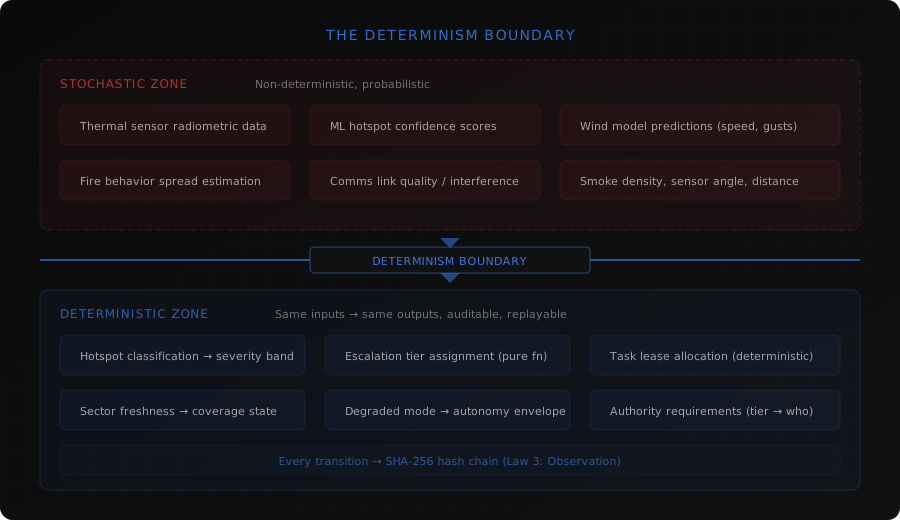
The determinism boundary

Sensor data is probabilistic. Governance decisions are deterministic. FireLaw draws a clear boundary between what is uncertain and what is auditable.

Determinism boundary diagram showing stochastic sensor inputs above and deterministic governance decisions below

The system never pretends certainty it does not have. Stochastic sensor outputs are recorded as-is. The governance layer applies deterministic rules to produce auditable, replayable decisions.

Governance

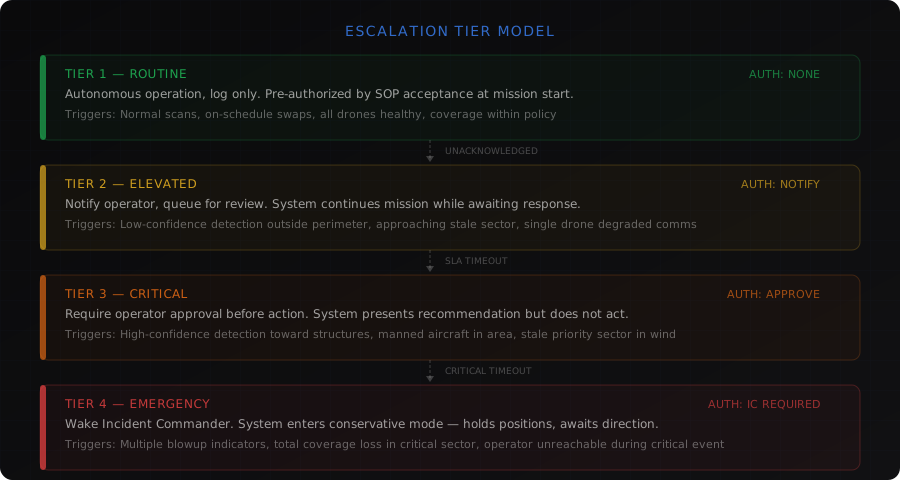
Four-tier escalation model

Deterministic escalation from sensor inputs to authority requirements. The escalation function is pure: same inputs always produce the same tier.

Four-tier escalation model: Routine, Elevated, Critical, Emergency with timeout ladder

Routine

Pre-authorized by SOP. System operates autonomously, logging all actions.

Elevated

Operator notified. Review queued. System continues mission while awaiting response.

Critical

Operator approval required before action. System recommends but does not act.

Emergency

IC notification. Conservative mode: hold positions, present situation summary.

Timeout ladder: Unacknowledged events auto-promote to the next tier. No detection is silently dropped due to operator unavailability.

Law 2: Delegation

Multi-asset task lease governance

The GCS does not command drones to perform tasks. It leases task authority under constrained terms: bounded in time, bounded in scope, revocable by the GCS.

No authority escalation

A drone cannot acquire authority its lease does not grant. A scan lease cannot become a verify lease without re-authorization.

Expiration returns to pool

When a lease expires, the task returns to the unassigned pool. The drone enters a holding state and awaits re-tasking.

Revocation is immediate

The GCS can revoke any lease at any time. This enables re-prioritization when critical detections demand resource reallocation.

Handoff preserves audit

When Drone A's lease expires and Drone B takes over, the audit trail records the complete chain with no gap in accountability.

GCS
Scan Sector 3 90s, renewable
Verify Detection #17 120s, non-renewable
Comms Relay 180s, renewable
Drone A
Drone B
Drone C
Degraded Mode

Less information, less authority — never more

When communications degrade, the system's autonomy envelope contracts. This is a constitutional principle of governed autonomy.

Comms State
Autonomy Envelope
Nominal
Full mission authority. All escalation tiers active. Task re-allocation enabled.
Reduced Bandwidth
Telemetry-only mode. Video suspended. Lease durations shortened. New detections queued.
Intermittent
Lease durations halved. No new assignments. Drones complete current lease then hold. All events escalate to CRITICAL.
Drone Isolated
Isolated drone completes scan, orbits, then RTL after timeout. Fleet reassigns task immediately.
GCS Isolated
All drones hold positions, then RTL. No new leases. Onboard FlightLaw (battery, geofence) remains active.
Full Partition
FireLaw governance suspended. Each drone on onboard FlightLaw safety floor. RTL after timeout. Detections logged locally.

In full partition, FireLaw cannot govern because it requires fleet-wide state awareness. The system falls back to FlightLaw — which operates entirely onboard — and guarantees that each individual drone remains safe. FlightLaw provides the safety floor. FireLaw provides the mission ceiling.

Law Composition

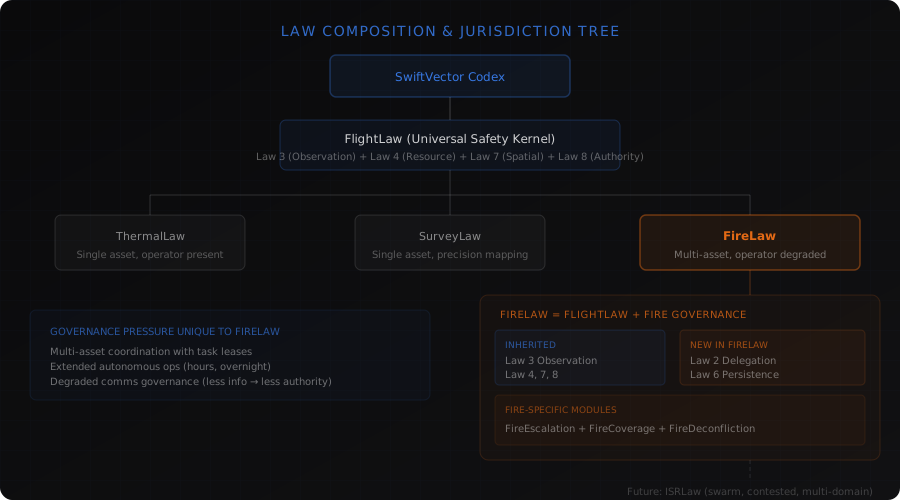
FireLaw jurisdiction

FireLaw composes FlightLaw's universal safety kernel with fire-specific governance: Law 2 (Delegation) for multi-asset task leases and Law 6 (Persistence) for immutable detection records.

Jurisdiction tree showing FireLaw composing FlightLaw with Law 2 and Law 6

Law 2: Delegation

Required because FireLaw governs multiple autonomous agents that must hand off tasks without operator intervention. Task leases ensure delegated authority cannot escalate — Drone B inherits exactly the permissions Drone A held, no more.

Law 6: Persistence

Required because fire perimeter state is safety-critical world knowledge. A sector marked as scanned cannot be retroactively reclassified. If new information contradicts prior state, it creates a new event — it does not mutate the historical record.

Evidence

Evidence is the primary product

The audit trail is not a diagnostic afterthought — it is what fire agencies are paying for. Every state transition from incident activation to mission end is deterministically replayable.

01

Timeline Replay

Every state transition, SOP acceptance, launch authorization, escalation event, operator decision, and automated action.

02

Detection Report

Each hotspot with GPS, thermal imagery, raw confidence, severity band, escalation tier, verification status.

03

Coverage Report

Per-sector scan history showing freshness over time, gaps, and the decisions that led to any gap.

04

Fleet Report

Per-drone tasks, battery consumption, comms quality, degraded mode transitions, RTL events.

05

Authority Report

Every escalation with trigger conditions, tier, notification sent, operator response, and resulting action.

06

System Health

Comms outages, GPS degradation, sensor anomalies, failsafe activations, degraded mode transitions.

All evidence is linked to a SHA-256 hash chain (Law 3). The evidence package includes the hash chain itself, enabling independent verification that no entries were added, removed, or modified after the fact.

SBIR Readiness

Simulation-first validation

FireLaw can be developed and demonstrated entirely in SITL simulation. The governance layer is pure logic that does not depend on physical sensors.

Full escalation scenario testing

Synthetic detections drive the complete escalation model through all four tiers with deterministic verification.

Coverage gap simulation

Configurable fleet sizes and perimeter complexity test coverage governance under resource constraints.

Degraded mode testing

Simulated comms failures at precise moments verify authority contraction at every degradation level.

Replay verification

Complex multi-asset scenarios replayed to confirm identical state hash output across runs.

Interested in fire monitoring governance?

FireLaw is Flightworks Control's lead demo target. We are actively seeking SBIR topic alignment and domain validation partnerships with fire agencies.