Mapping Pilots
Mapping workflows use field-tested practices with explicit approvals and audit-ready mission records.
Select projects use field-tested workflows from mission planning through audit-ready documentation.
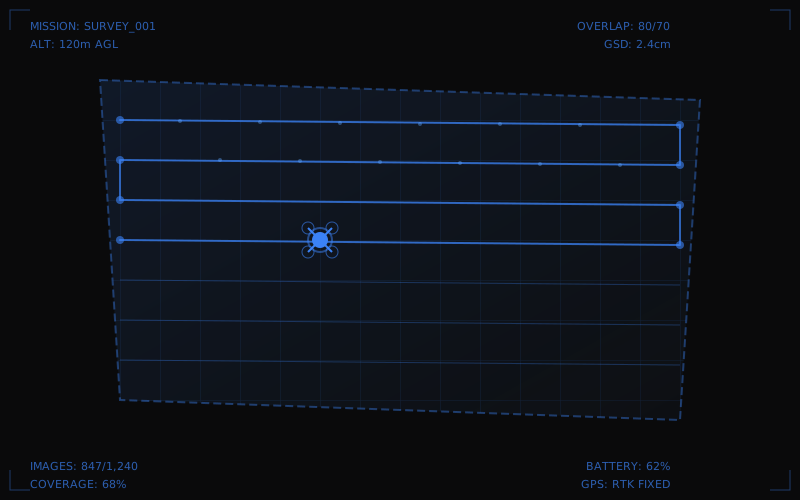
Draw or import your target boundary. The GCS calculates optimal flight paths based on terrain, desired resolution, and aircraft capabilities.
The system generates waypoints with precise camera triggers, ensuring consistent overlap (typically 80% front, 70% side) for photogrammetric processing.
High-resolution cameras capture hundreds to thousands of overlapping images, each geotagged with precise GPS coordinates for accurate positioning.
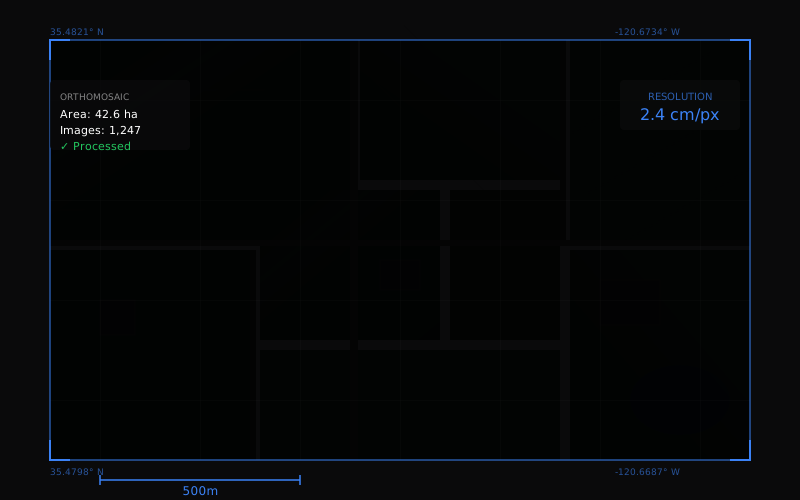
Photogrammetric processing stitches imagery into seamless orthomosaics, generates elevation models, and creates 3D point clouds or mesh reconstructions.
Crop health monitoring, field boundary mapping, drainage analysis, and yield estimation through regular aerial surveys.
Progress documentation, volumetric calculations, site planning, and as-built surveys with centimeter-level accuracy.
Property surveys, boundary delineation, erosion monitoring, and conservation planning for large areas.
Traditional survey augmentation with dense point clouds, enabling faster data collection over difficult terrain.
Pilot engagements can generate multiple data products for analysis and review.
Geometrically corrected, georeferenced aerial imagery stitched into a seamless map with real-world accuracy.
Terrain and surface elevation data for volumetric analysis, drainage modeling, and topographic visualization.
Dense point clouds for detailed measurements, BIM integration, and volumetric calculations.
Mapping operations inform governance requirements for Flightworks Control. See also: Fire Perimeter Monitoring — the lead demo target for overnight governed autonomy.
Pilot engagements are limited and focused on validating governance-first workflows.